
Authors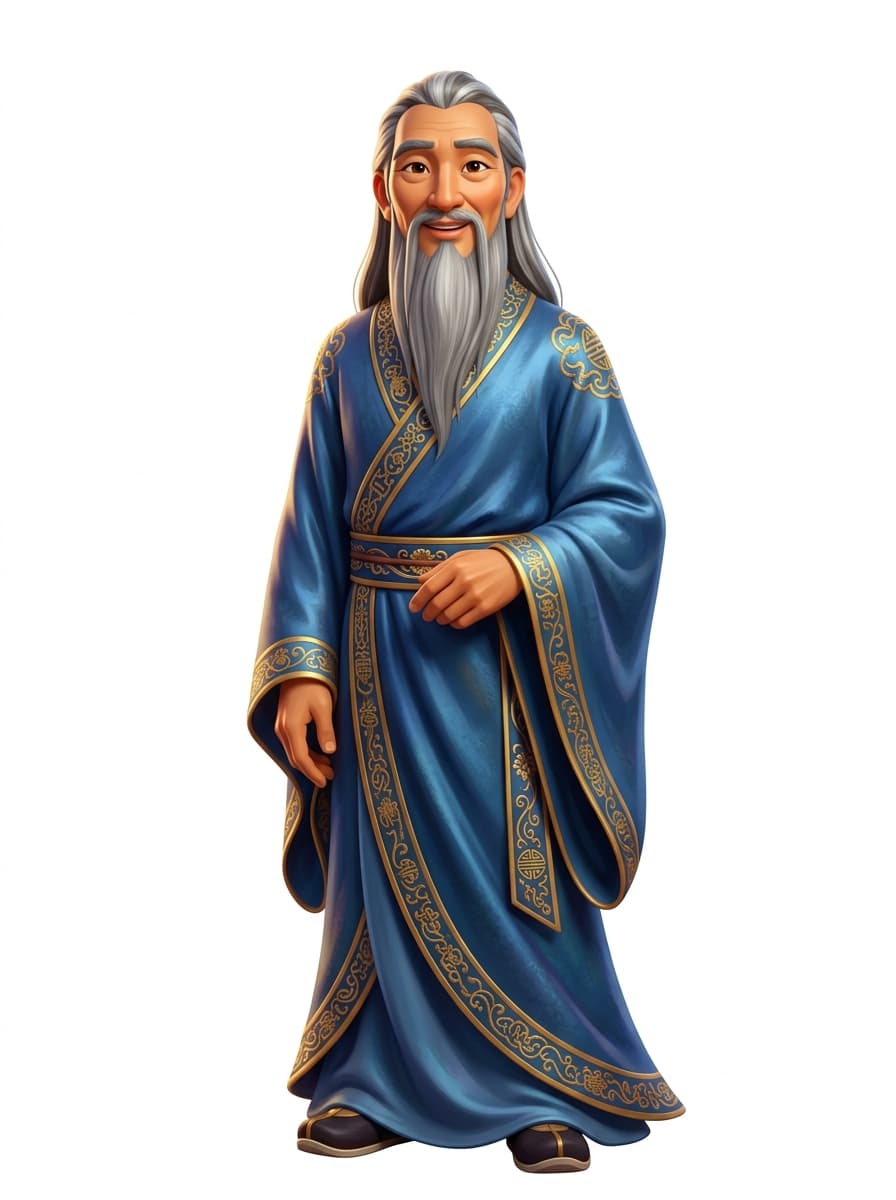
Confucius
551 BC – 479 BC
Confucius was a teacher and philosopher who lived in ancient China more than 2,500 years ago. He taught that kindness, respect, and lifelong learning build a good life and a fair society, though he spent much of his life traveling from state to state failing to convince rulers to adopt his ideas. His students collected his sayings into a book, the Analects, which centuries after his death became the foundation of China's civil service exams for over a thousand years and is still studied around the world today.
Quotes
“It does not matter how slowly you go as long as you do not stop.”
“Study the past if you would define the future.”
“By three methods we may learn wisdom: first, by reflection; second, by imitation; third, by experience.”
“If you see what is right and fail to act on it, you lack courage.”
“Only after Winter comes do we know that the pine and the cypress are the last to fade.”
“Learning without thought is labor lost; thought without learning is perilous.”
“Is it not delightful to have friends coming from distant quarters?”
“What you do not want done to yourself, do not do to others.”
“To see what is right and not to do it is want of courage.”
“Friendship with the upright; friendship with the sincere; and friendship with the man of much observation:-- these are advantageous.”
“Faithfully admonish your friend, and skillfully lead him on. If you find him impracticable, stop. Do not disgrace yourself.”
“A youth, when at home, should be filial, and, abroad, respectful to his elders. He should be earnest and truthful. He should overflow in love to all, and cultivate the friendship of the good. When he has time and opportunity, after the performance of these things, he should employ them in polite studies.”
“Parents are anxious lest their children should be sick.”
“If a man keeps cherishing his old knowledge, so as continually to be acquiring new, he may be a teacher of others.”
“Learning without thought is labour lost; thought without learning is perilous.”
“When you know a thing, to hold that you know it; and when you do not know a thing, to allow that you do not know it;— this is knowledge.”
“The years of parents may by no means not be kept in the memory, as an occasion at once for joy and for fear.”
“I do not open up the truth to one who is not eager to get knowledge, nor help out any one who is not anxious to explain himself. When I have presented one corner of a subject to any one, and he cannot from it learn the other three, I do not repeat my lesson.”
“When I walk along with two others, they may serve me as my teachers. I will select their good qualities and follow them, their bad qualities and avoid them.”
“A youth is to be regarded with respect. How do we know that his future will not be equal to our present?”
“In teaching there should be no distinction of classes.”
“When the year becomes cold, then we know how the pine and the cypress are the last to lose their leaves.”
“Fine words and an insinuating appearance are seldom associated with true virtue.”
“He who aims to be a man of complete virtue in his food does not seek to gratify his appetite, nor in his dwelling place does he seek the appliances of ease; he is earnest in what he is doing, and careful in his speech; he frequents the company of men of principle that he may be rectified:— such a person may be said indeed to love to learn.”
“I will not be afflicted at men's not knowing me; I will be afflicted that I do not know men.”
“At seventy, I could follow what my heart desired, without transgressing what was right.”
“See what a man does. Mark his motives. Examine in what things he rests.”
“He acts before he speaks, and afterwards speaks according to his actions.”
“I do not know how a man without truthfulness is to get on. How can a large carriage be made to go without the cross-bar for yoking the oxen to, or a small carriage without the arrangement for yoking the horses?”
“I could describe the ceremonies of the Hsia dynasty, but Chi cannot sufficiently attest my words. I could describe the ceremonies of the Yin dynasty, but Sung cannot sufficiently attest my words. (They cannot do so) because of the insufficiency of their records and wise men. If those were sufficient, I could adduce them in support of my words.”
“In archery it is not going through the leather which is the principal thing;— because people's strength is not equal. This was the old way.”
“Things that are done, it is needless to speak about; things that have had their course, it is needless to remonstrate about; things that are past, it is needless to blame.”
“It is virtuous manners which constitute the excellence of a neighborhood. If a man in selecting a residence, do not fix on one where such prevail, how can he be wise?”
“If the will be set on virtue, there will be no practice of wickedness.”
“If a man in the morning hear the right way, he may die in the evening without regret.”
“The superior man, in the world, does not set his mind either for anything, or against anything; what is right he will follow.”
“He who acts with a constant view to his own advantage will be much murmured against.”
“A man should say, I am not concerned that I have no place, I am concerned how I may fit myself for one. I am not concerned that I am not known, I seek to be worthy to be known.”
“When we see men of worth, we should think of equalling them; when we see men of a contrary character, we should turn inwards and examine ourselves.”
“The reason why the ancients did not readily give utterance to their words, was that they feared lest their actions should not come up to them.”
“The superior man wishes to be slow in his speech and earnest in his conduct.”
“Virtue is not left to stand alone. He who practises it will have neighbors.”
“In a hamlet of ten families, there may be found one honourable and sincere as I am, but not so fond of learning.”
“Admirable indeed was the virtue of Hui! With a single bamboo dish of rice, a single gourd dish of drink, and living in his mean narrow lane, while others could not have endured the distress, he did not allow his joy to be affected by it. Admirable indeed was the virtue of Hui!”
“Where the solid qualities are in excess of accomplishments, we have rusticity; where the accomplishments are in excess of the solid qualities, we have the manners of a clerk. When the accomplishments and solid qualities are equally blended, we then have the man of virtue.”
“They who know the truth are not equal to those who love it, and they who love it are not equal to those who delight in it.”
“The wise find pleasure in water; the virtuous find pleasure in hills. The wise are active; the virtuous are tranquil. The wise are joyful; the virtuous are long-lived.”
“The superior man, extensively studying all learning, and keeping himself under the restraint of the rules of propriety, may thus likewise not overstep what is right.”
“A transmitter and not a maker, believing in and loving the ancients, I venture to compare myself with our old P'ang.”
“The silent treasuring up of knowledge; learning without satiety; and instructing others without being wearied:— which one of these things belongs to me?”
“The leaving virtue without proper cultivation; the not thoroughly discussing what is learned; not being able to move towards righteousness of which a knowledge is gained; and not being able to change what is not good:— these are the things which occasion me solicitude.”
“If the search for riches is sure to be successful, though I should become a groom with whip in hand to get them, I will do so. As the search may not be successful, I will follow after that which I love.”
“With coarse rice to eat, with water to drink, and my bended arm for a pillow;— I have still joy in the midst of these things. Riches and honours acquired by unrighteousness, are to me as a floating cloud.”
“I am not one who was born in the possession of knowledge; I am one who is fond of antiquity, and earnest in seeking it there.”
“Do you think, my disciples, that I have any concealments? I conceal nothing from you. There is nothing which I do that is not shown to you, my disciples;— that is my way.”
“There may be those who act without knowing why. I do not do so. Hearing much and selecting what is good and following it; seeing much and keeping it in memory:— this is the second style of knowledge.”
“Is virtue a thing remote? I wish to be virtuous, and lo! virtue is at hand.”
“In letters I am perhaps equal to other men, but the character of the superior man, carrying out in his conduct what he professes, is what I have not yet attained to.”
“The sage and the man of perfect virtue;— how dare I rank myself with them? It may simply be said of me, that I strive to become such without satiety, and teach others without weariness.”
“Though a man have abilities as admirable as those of the Duke of Chau, yet if he be proud and niggardly, those other things are really not worth being looked at.”
“Learn as if you could not reach your object, and were always fearing also lest you should lose it.”
“It passes on just like this, not ceasing day or night!”
“The prosecution of learning may be compared to what may happen in raising a mound. If there want but one basket of earth to complete the work, and I stop, the stopping is my own work. It may be compared to throwing down the earth on the level ground. Though but one basketful is thrown at a time, the advancing with it is my own going forward.”
“There are cases in which the blade springs, but the plant does not go on to flower! There are cases where it flowers, but no fruit is subsequently produced!”
“Can men refuse to assent to the words of strict admonition? But it is reforming the conduct because of them which is valuable. Can men refuse to be pleased with words of gentle advice? But it is unfolding their aim which is valuable. If a man be pleased with these words, but does not unfold their aim, and assents to those, but does not reform his conduct, I can really do nothing with him.”
“The commander of the forces of a large state may be carried off, but the will of even a common man cannot be taken from him.”
“The wise are free from perplexities; the virtuous from anxiety; and the bold from fear.”
“If, because a man's discourse appears solid and sincere, we allow him to be a good man, is he really a superior man? or is his gravity only in appearance?”
“In hearing litigations, I am like any other body. What is necessary, however, is to cause the people to have no litigations.”
“Though a man may be able to recite the three hundred odes, yet if, when intrusted with a governmental charge, he knows not how to act, or if, when sent to any quarter on a mission, he cannot give his replies unassisted, notwithstanding the extent of his learning, of what practical use is it?”
“If a minister make his own conduct correct, what difficulty will he have in assisting in government? If he cannot rectify himself, what has he to do with rectifying others?”
“The firm, the enduring, the simple, and the modest are near to virtue.”
“The virtuous will be sure to speak correctly, but those whose speech is good may not always be virtuous. Men of principle are sure to be bold, but those who are bold may not always be men of principle.”
“Can there be love which does not lead to strictness with its object? Can there be loyalty which does not lead to the instruction of its object?”
“To be poor without murmuring is difficult. To be rich without being proud is easy.”
“He who speaks without modesty will find it difficult to make his words good.”
“In ancient times, men learned with a view to their own improvement. Now-a-days, men learn with a view to the approbation of others.”
“The superior man is modest in his speech, but exceeds in his actions.”
“I will not be concerned at men's not knowing me; I will be concerned at my own want of ability.”
“He who does not anticipate attempts to deceive him, nor think beforehand of his not being believed, and yet apprehends these things readily (when they occur);— is he not a man of superior worth?”
“A horse is called a ch'i, not because of its strength, but because of its other good qualities.”
“When a man may be spoken with, not to speak to him is to err in reference to the man. When a man may not be spoken with, to speak to him is to err in reference to our words. The wise err neither in regard to their man nor to their words.”
“If a man take no thought about what is distant, he will find sorrow near at hand.”
“He who requires much from himself and little from others, will keep himself from being the object of resentment.”
“The superior man in everything considers righteousness to be essential. He performs it according to the rules of propriety. He brings it forth in humility. He completes it with sincerity. This is indeed a superior man.”
“The superior man is dignified, but does not wrangle. He is sociable, but not a partizan.”
“The superior man does not promote a man simply on account of his words, nor does he put aside good words because of the man.”
“Specious words confound virtue. Want of forbearance in small matters confounds great plans.”
“When the multitude hate a man, it is necessary to examine into the case. When the multitude like a man, it is necessary to examine into the case.”
“A man can enlarge the principles which he follows; those principles do not enlarge the man.”
“To have faults and not to reform them,— this, indeed, should be pronounced having faults.”
“I have been the whole day without eating, and the whole night without sleeping:— occupied with thinking. It was of no use. The better plan is to learn.”
“Let every man consider virtue as what devolves on himself. He may not yield the performance of it even to his teacher.”
“The superior man is correctly firm, and not firm merely.”
“In language it is simply required that it convey the meaning.”
“By nature, men are nearly alike; by practice, they get to be wide apart.”