
Authors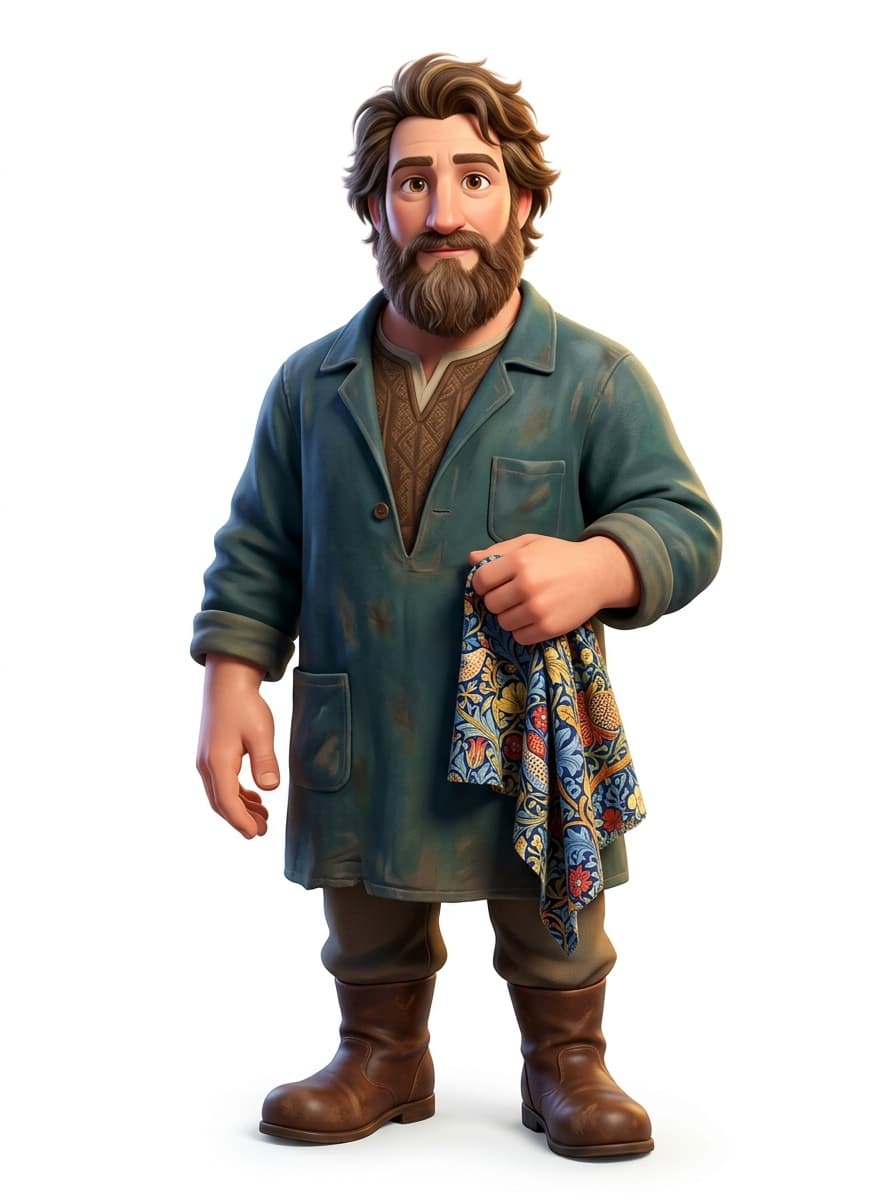
William Morris
1834 – 1896
William Morris was an English textile designer, writer, and craftsman who led the Arts and Crafts movement, championing beautifully made, handcrafted goods over cheap factory production. His richly patterned wallpapers and fabrics, often featuring flowers, leaves, and birds, are still produced and loved today. He also wrote poetry and fantasy novels and was an early voice for socialism in Britain.
Quotes
“Have nothing in your houses that you do not know to be useful, or believe to be beautiful.”
“In a true society these miracles of ingenuity would be for the first time used for minimizing the amount of time spent in unattractive labour, which by their means might be so reduced as to be but a very light burden on each individual.”
“Of all that I have to say to you this seems to me the most important, that our daily and necessary work, which we could not escape if we would, which we would not forego if we could, should be human, serious, and pleasurable, not machine-like, trivial, or grievous.”
“Some work, nay, almost all the work done by artisans is too mechanical; and those that work at it must either abstract their thoughts from it altogether, in which case they are but machines while they are at work; or else they must suffer such dreadful weariness in getting through it, as one can scarcely bear to think of.”
“But that education does not end when people leave school is now a mere commonplace; and how then can you really educate men who lead the life of machines, who only think for the few hours during which they are not at work, who in short spend almost their whole lives in doing work which is not proper for developing them body and mind in some worthy way?”
“So I say that, in spite of our inventions, no worker works under the present system an hour the less on account of those labour-saving machines, so-called.”
“Again, if the necessary reasonable work be of a mechanical kind, I must be helped to do it by a machine, not to cheapen my labour, but so that as little time as possible may be spent upon it, and that I may be able to think of other things while am tending the machine.”
“I don’t quite admit that; it is the allowing machines to be our masters and not our servants that so injures the beauty of life nowadays.”
“And I have a kind of hope that the very elaboration of machinery in a society whose purpose is not the multiplication of labour, as it now is, but the carrying on of a pleasant life, as it would be under social order—that the elaboration of machinery, I say, will lead the simplification of life, and so once more to the limitation of machinery.”
“Need I dwell on the fact that, under these circumstances, the invention of the machines has benefited the workman but little even to this day?”
“There are some things which a machine can do as well as a man’s hand, plus a tool, can do them.”
“That, so far, is unmixed gain in the use of a machine—always, mind you, supposing equality of condition among men; no art is lost, leisure or time for more pleasurable work is gained.”
“To avoid misunderstanding, I must say that I am thinking of the modern machine, which is as it were alive, and to which the man is auxiliary, and not of the old machine, the improved tool, which is auxiliary to the man, and only works as long as his hand is thinking; though I will remark, that even this elementary form of machine has to be dropped when we come to the higher and more intricate forms of art.”
“Well, as to the machine proper used for art, when it gets to the stage above dealing with a necessary production that has accidentally some beauty about it, a reasonable man with a feeling for art will only use it when he is forced to.”
“If he thinks he would like ornament, for instance, and knows that the machine cannot do it properly, and does not care to spend the time to do it properly, why should he do it at all?”
“I suppose that this is what is likely to happen; that machinery will go on developing, with the purpose of saving men labour, till the mass of the people attain real leisure enough to be able to appreciate the pleasure of life; till, in fact, they have attained such mastery over Nature that they no longer fear starvation as a penalty for not working more than enough.”
“And as the Artificial Famine, caused by men working for the profit of a master, and which we now look upon as a matter of course, would have long disappeared, they would be free to do as they chose, and they would set aside their machines in all cases where the work seemed pleasant or desirable for handiwork; till in all crafts where production of beauty was required, the most direct communication between a man’s hand and his brain would be sought for.”
“And there would be many occupations also, as the processes of agriculture, in which the voluntary exercise of energy would be thought so delightful, that people would not dream of handing over its pleasure to the jaws of a machine.”
“The multiplication of labour has become a necessity for us, and as long as that goes on no ingenuity in the invention of machines will be of any real use to us.”
“The factories might be centres of intellectual activity also, and work in them might well be varied very much: the tending of the necessary machinery might to each individual be but a short part of the day’s work.”
“Science duly applied would enable them to get rid of refuse, to minimize, if not wholly to destroy, all the inconveniences which at present attend the use of elaborate machinery, such as smoke, stench and noise; nor would they endure that the buildings in which they worked or lived should be ugly blots on the fair face of the earth.”
“Our epoch has invented machines which would have appeared wild dreams to the men of past ages, and of those machines we have as yet made no use .”
“They are called “labour-saving” machines—a commonly used phrase which implies what we expect of them; but we do not get what we expect.”
“All the more as these machines would most certainly be very much improved when it was no longer a question as to whether their improvement would “pay” the individual, but rather whether it would benefit the community.”
“So much for the ordinary use of machinery, which would probably, after a time, be somewhat restricted when men found out that there was no need for anxiety as to mere subsistence, and learned to take an interest and pleasure in handiwork which, done deliberately and thoughtfully, could be made more attractive than machine work.”
“Our subject is that great body of art, by means of which men have at all times more or less striven to beautify the familiar matters of everyday life: a wide subject, a great industry; both a great part of the history of the world, and a most helpful instrument to the study of that history.”
“Time was when the mystery and wonder of handicrafts were well acknowledged by the world, when imagination and fancy mingled with all things made by man; and in those days all handicraftsmen were artists, as we should now call them.”
“But the thought of man became more intricate, more difficult to express; art grew a heavier thing to deal with, and its labour was more divided among great men, lesser men, and little men; till that art, which was once scarce more than a rest of body and soul, as the hand cast the shuttle or swung the hammer, became to some men so serious labour, that their working lives have been one long tragedy of hope and fear, joy and trouble.”
“This was the growth of art: like all growth, it was good and fruitful for awhile; like all fruitful growth, it grew into decay; like all decay of what was once fruitful, it will grow into something new.”
“The artist came out from the handicraftsmen, and left them without hope of elevation, while he himself was left without the help of intelligent, industrious sympathy.”
“I hold that men would wake up after a while, and look round and find the dulness unbearable, and begin once more inventing, imitating, and imagining, as in earlier days.”
“By what means then shall those work who long for reform in the arts, and who shall they seek to kindle into eager desire for possession of beauty, and better still, for the development of the faculty that creates beauty?”
“You whose hands make those things that should be works of art, you must be all artists, and good artists too, before the public at large can take real interest in such things; and when you have become so, I promise you that you shall lead the fashion; fashion shall follow your hands obediently enough.”
“As to the second, I do not think that any man but one of the highest genius, could do anything in these days without much study of ancient art, and even he would be much hindered if he lacked it.”
“Let us therefore study it wisely, be taught by it, kindled by it; all the while determining not to imitate or repeat it; to have either no art at all, or an art which we have made our own.”
“But moreover you may sometimes have an opportunity of studying ancient art in a narrower but a more intimate, a more kindly form, the monuments of our own land.”
“Of course, however, both as an instrument of that study we have been speaking of, as well as of the practice of the arts, all handicraftsmen should be taught to draw very carefully; as indeed all people should be taught drawing who are not physically incapable of learning it: but the art of drawing so taught would not be the art of designing, but only a means towards this end, general capability in dealing with the arts.”
“I beg you to remember both as a remedy against this, and as explaining exactly what I mean, that nothing can be a work of art which is not useful; that is to say, which does not minister to the body when well under command of the mind, or which does not amuse, soothe, or elevate the mind in a healthy state.”
“Simplicity of life, begetting simplicity of taste, that is, a love for sweet and lofty things, is of all matters most necessary for the birth of the new and better art we crave for; simplicity everywhere, in the palace as well as in the cottage.”
“Anyhow, however it be done, unless people care about carrying on their business without making the world hideous, how can they care about Art?”
“Sirs, I believe that art has such sympathy with cheerful freedom, open-heartedness and reality, so much she sickens under selfishness and luxury, that she will not live thus isolated and exclusive.”
“I do not want art for a few, any more than education for a few, or freedom for a few.”
“Those of you who are real artists know well enough all the special advice I can give you, and in how few words it may be said—follow nature, study antiquity, make your own art, and do not steal it, grudge no expense of trouble, patience, or courage, in the striving to accomplish the hard thing you have set yourselves to do.”
“But to me, and I hope to you, Art is a very serious thing, and cannot by any means be dissociated from the weighty matters that occupy the thoughts of men; and there are principles underlying the practice of it, on which all serious-minded men, may—nay, must—have their own thoughts.”
“Who can say how little we should know of many periods, but for their art?”
“History (so called) has remembered the kings and warriors, because they destroyed; Art has remembered the people, because they created.”
“Nor is such an art as we long for a vain dream; such an art once was in times that were worse than these, when there was less courage, kindness, and truth in the world than there is now; such an art there will be hereafter, when there will be more courage, kindness, and truth than there is now in the world.”
“That thing which I understand by real art is the expression by man of his pleasure in labour.”
“Do not, at any rate, shelter yourselves from any misgiving you may have behind the fallacy that the art-lacking labour of to-day is happy work: for the most of men it is not so.”
“As to the bricklayer, the mason, and the like—these would be artists, and doing not only necessary, but beautiful, and therefore happy work, if art were anything like what it should be.”
“I suppose you will think it too commonplace of me to say that the general education that makes men think, will one day make them think rightly upon art.”
“However, I cannot forget that, in my mind, it is not possible to dissociate art from morality, politics, and religion.”
“So I will say that I believe there are two virtues much needed in modern life, if it is ever to become sweet; and I am quite sure that they are absolutely necessary in the sowing the seed of an art which is to be made by the people and for the people, as a happiness to the maker and the user.”
“Nay, and apart from the morality of the matter, which I am forced to speak to you of; let me tell you that though simplicity in art may be costly as well as uncostly, at least it is not wasteful, and nothing is more destructive to art than the want of it.”
“But if to any of you I have seemed to speak hopelessly, my words have been lacking in art; and you must remember that hopelessness would have locked my mouth, not opened it.”
“Yes, surely these times are wonderful and fruitful of change, which, as it wears and gathers new life even in its wearing, will one day bring better things for the toiling days of men, who, with freer hearts and clearer eyes, will once more gain the sense of outward beauty, and rejoice in it.”
“The danger that the present course of civilisation will destroy the beauty of life—these are hard words, and I wish I could mend them, but I cannot, while I speak what I believe to be the truth.”
“You cannot educate, you cannot civilise men, unless you can give them a share in art.”
“Surely if it be worth while troubling ourselves about the works of art of to-day, of which any amount almost can be done, since we are yet alive, it is worth while spending a little care, forethought, and money in preserving the art of bygone ages, of which (woe worth the while!) so little is left, and of which we can never have any more, whatever good-hap the world may attain to.”
“Pray do not forget, that any one who cuts down a tree wantonly or carelessly, especially in a great town or its suburbs, need make no pretence of caring about art.”
“What else can we do to help to educate ourselves and others in the path of art, to be on the road to attaining an Art made by the people and for the people as a joy to the maker and the user?”
“It seems to me that, by a great piece of good luck, the way to pay for them is by doing that which alone can produce popular art among us: living a simple life, I mean.”
“Once more I say that the greatest foe to art is luxury, art cannot live in its atmosphere.”
“All art starts from this simplicity; and the higher the art rises, the greater the simplicity.”
“Now after all, for us who are learning art, it is not far to seek what is the surest way to further it; that which most breeds art is art; every piece of work that we do which is well done, is so much help to the cause; every piece of pretence and half-heartedness is so much hurt to it.”
“That cause is the Democracy of Art, the ennobling of daily and common work, which will one day put hope and pleasure in the place of fear and pain, as the forces which move men to labour and keep the world a-going.”
“Yet even then one might be excused for thinking that the wild rose was scarce improved on, for nothing can be more beautiful in general growth or in detail than a wayside bush of it, nor can any scent be as sweet and pure as its scent.”
“We could have a few real works of art at the same price for which we now have hundreds of yards of makeshift machine-woven goods.”
“Then there is a natural and beautiful way of ornamenting a ceiling by working the plaster into delicate patterns, such as you see in our Elizabethan and Jacobean houses; which often enough, richly designed and skilfully wrought as they are, are by no means pedantically smooth in finish—nay, may sometimes be called rough as to workmanship.”
“The excellence of this sort of work lies in a clear but soft relief of the form, in colours each beautiful in itself, and harmonious one with the other on ground whose colour is also beautiful, though unobtrusive.”
“To have a meaning and to make others feel and understand it, must ever be the aim and end of our Western art.”
“Now order imposes on us certain limitations, which partly spring from the nature of the art itself, and partly from the materials in which we have to work; and it is a sign of mere incompetence in either a school or an individual to refuse to accept such limitations, or even not to accept them joyfully and turn them to special account, much as if a poet should complain of having to write in measure and rhyme.”
“It follows from this that your convention must be your own, and not borrowed from other times and peoples; or, at the least, that you must make it your own by thoroughly understanding both the nature and the art you are dealing with.”
“You must master it so far as to make it express a meaning, and to serve your aim at beauty.”
“First clear steady principle, then playing with the danger, and lastly falling into the snare, mark with the utmost distinctness the times of the health, the decline, and the last sickness of art.”
“We should not be able to read the whole thing at once, nor desire to do so, nor be impelled by that desire to go on tracing line after line to find out how the pattern is made, and I think that the obvious presence of a geometrical order, if it be, as it should be, beautiful, tends towards this end, and prevents our feeling restless over a pattern.”
“Finally, no amount of delicacy is too great in drawing the curves of a pattern, no amount of care in getting the leading lines right from the first, can be thrown away, for beauty of detail cannot afterwards cure any shortcoming in this.”
“As to the second moral quality of design, meaning, I include in that the invention and imagination which forms the soul of this art, as of all others, and which, when submitted to the bonds of order, has a body and a visible existence.”
“So I will content myself with saying this on these qualities, that though a designer may put all manner of strangeness and surprise into his patterns, he must not do so at the expense of beauty.”
“The fertile man, he of resource, has not to worry himself about invention.”
“He need but think of beauty and simplicity of expression; his work will grow on and on, one thing leading to another, as it fares with a beautiful tree.”
“True it is that that meaning may have come down to us traditionally, and not be our own invention, yet we must at heart understand it, or we can neither receive it, nor hand it down to our successors.”
“For you know all art is compact of effort, of failure and of hope, and we cannot but think that somewhere perfection lies ahead, as we look anxiously for the better thing that is to come from the good.”
“Belike the thoughts of the men who wrought this kind of art could not have been expressed in grander ways or more definitely, or, at least, would not have been; therefore I believe I am not thinking only of my own pleasure, but of the pleasure of many people, when I praise the usefulness of the lives of these men, whose names are long forgotten, but whose works we still wonder at.”
“Furthermore, no room of the richest man should look grand enough to make a simple man shrink in it, or luxurious enough to make a thoughtful man feel ashamed in it; it will not do so if Art be at home there, for she has no foes so deadly as insolence and waste.”
“Art was not born in the palace; rather she fell sick there, and it will take more bracing air than that of rich men’s houses to heal her again.”
“Yet to my mind real art is cheap, even at the price that must be paid for it.”
“Anyhow, let us make up our minds which we want, art, or the absence of art, and be prepared if we want art, to give up many things, and in many ways to change the conditions of life.”
“The word Architecture has, I suppose, to most of you the meaning of the art of building nobly and ornamentally.”
“Now I believe the practice of this art to be one of the most important things which man can turn his hand to, and the consideration of it to be worth the attention of serious people, not for an hour only, but for a good part of their lives, even though they may not have to do with it professionally.”
“But, noble as that art is by itself, and though it is specially the art of civilisation, it neither ever has existed nor never can exist alive and progressive by itself, but must cherish and be cherished by all the crafts whereby men make the things which they intend shall be beautiful, and shall last somewhat beyond the passing day.”
“Maybe indeed that many things which I think beautiful you will deem of small account; nay, that even some things I think base and ugly will not vex your eyes or your minds: but one thing I know you will none of you like to plead guilty to; blindness to the natural beauty of the earth; and of that beauty art is the only possible guardian.”
“In this and in many other ways it may differ from the past art, but in one thing it must needs be like it; it will not be an esoteric mystery shared by a little band of superior beings; it will be no more hierarchical than the art of past time was, but like it will be a gift of the people to the people, a thing which everybody can understand, and every one surround with love; it will be a part of every life, and a hindrance to none.”
“There is the hard business for us! to get all simple people to care about art, to get them to insist on making it part of their lives, whatever becomes of systems of commerce and labour held perfect by some of us.”
“How shall we give them leisure from toil, and truce with anxiety, so that they may have time to brood over the longing for beauty which men are born with, as ’tis said, even in London streets?”
“Yet such were even now the state of art were it not for that hope which I am here to set forth to you, the hope of an art that shall express the soul of the people.”
“How shall we set about giving people without traditions of art eyes with which to see works of art?”
“How shall people in general get leisure enough from toil, and truce enough with anxiety to give scope to their inborn longing for beauty?”
“Properly speaking, this work is all pleasure: true, there are pains and perplexities and weariness in it, but they are like the troubles of a beautiful life; the dark places that make the bright ones brighter: they are the romance of the work and do but elevate the workman, not depress him: I would call this Imaginative Work.”
“Indeed when Intelligent work coexists with Imaginative, there is no hard and fast line between them; in the very best and happiest times of art, there is scarce any Intelligent work which is not Imaginative also; and there is but little of effort or doubt, or sign of unexpressed desires even in the highest of the Imaginative work: the blessing of Equality elevates the lesser, and calms the greater, art.”
“Imaginative work is the very blossom of civilisation triumphant and hopeful; it would fain lead men to aspire towards perfection: each hope that it fulfils gives birth to yet another hope: it bears in its bosom the worth and the meaning of life and the counsel to strive to understand everything; to fear nothing and to hate nothing: in a word, ’tis the symbol and sacrament of the Courage of the World.”
“At first sight its hope of victory is slender indeed: yet to us now living it seems as if man had not yet lost all that part of his soul which longs for beauty: nay we cannot but hope that it is not yet dying.”
“For Art breeds Art, and every worthy work done and delighted in by maker and user begets a longing for more: and since art cannot be fashioned by mechanical toil, the demand for real art will mean a demand for intelligent work, which if persisted in will in time create its due supply—at least I hope so.”
“Now if the public knew anything of art, that is excellence in things made by man, they would not abide the shams of it; and if the real thing were not to be had, they would learn to do without, nor think their gentility injured by the forbearance.”
“So I say, if you cannot learn to love real art, at least learn to hate sham art and reject it.”
“Let us remember this, and amid simplicity of life turn our eyes to real beauty that can be shared by all: and then though the days worsen, and no rag of the elder art be left for our teaching, yet the new art may yet arise among us, and even if it have the hands of a child together with the heart of a troubled man, still it may bear on for us to better times the tokens of our reverence for the Life of Man upon the Earth.”