
Authors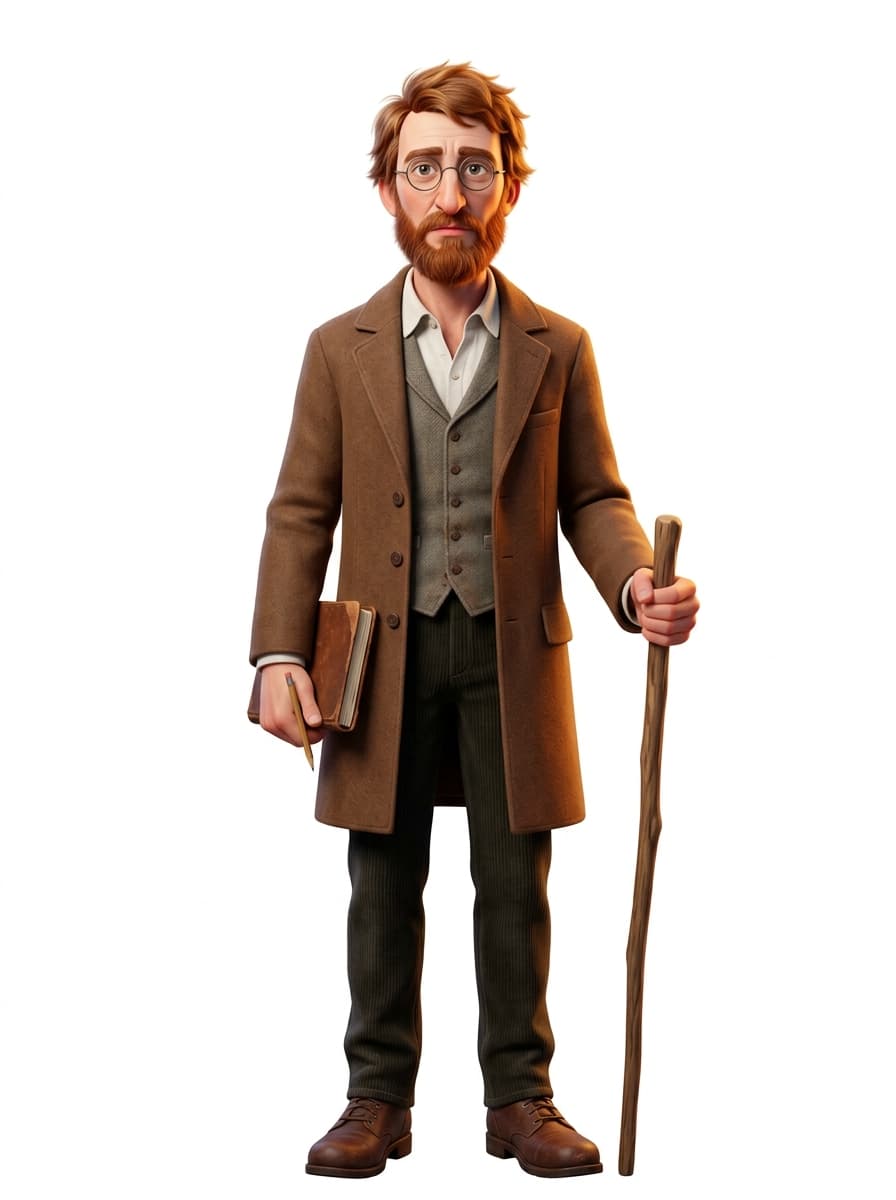
Henry David Thoreau
1817 – 1862
Henry David Thoreau was an American writer who spent two years living simply in a small cabin near Walden Pond, writing about nature, independence, and living deliberately. His book Walden and his essay on civil disobedience — refusing to follow unjust laws, an idea sparked by a night he spent in jail for refusing to pay a tax in protest of slavery — influenced later activists like Gandhi and Martin Luther King Jr. He believed people could learn the most important lessons by paying close attention to the natural world around them.
Quotes
“In wildness is the preservation of the world.”
“If a man does not keep pace with his companions, perhaps it is because he hears a different drummer.”
“If you have built castles in the air, your work need not be lost; that is where they should be. Now put the foundations under them.”
“The mass of men lead lives of quiet desperation.”
“Our life is frittered away by detail.”
“Rather than love, than money, than fame, give me truth.”
“I never found the companion that was so companionable as solitude.”
“Things do not change; we change.”
“The sun is but a morning star.”
“Heaven is under our feet as well as over our heads.”
“I went to the woods because I wished to live deliberately”
“I wanted to live deep and suck out all the marrow of life”
“A man is rich in proportion to the number of things which he can afford to let alone.”
“Books are the treasured wealth of the world and the fit inheritance of generations and nations.”
“To affect the quality of the day, that is the highest of arts.”
“The cost of a thing is the amount of what I will call life which is required to be exchanged for it”
“But, to speak practically and as a citizen, unlike those who call themselves no-government men, I ask for, not at once no government, but at once a better government.”
“Must the citizen ever for a moment, or in the least degree, resign his conscience to the legislator?”
“It is truly enough said that a corporation has no conscience; but a corporation of conscientious men is a corporation with a conscience.”
“Can there not be a government in which the majorities do not virtually decide right and wrong, but conscience?—in which majorities decide only those questions to which the rule of expediency is applicable?”
“But a government in which the majority rule in all cases can not be based on justice, even as far as men understand it.”
“A very few, as heroes, patriots, martyrs, reformers in the great sense, and men, serve the State with their consciences also, and so necessarily resist it for the most part; and they are commonly treated by it as enemies.”
“All men recognize the right of revolution; that is, the right to refuse allegiance to and to resist the government, when its tyranny or its inefficiency are great and unendurable.”
“This people must cease to hold slaves, and to make war on Mexico, though it cost them their existence as a people.”
“Only his vote can hasten the abolition of slavery who asserts his own freedom by his vote.”
“Is there not a sort of blood shed when the conscience is wounded?”
“If the alternative is to keep all just men in prison, or give up war and slavery, the State will not hesitate which to choose.”
“I have never declined paying the highway tax, because I am as desirous of being a good neighbor as I am of being a bad subject; and, as for supporting schools, I am doing my part to educate my fellow-countrymen now.”
“Truth is always in harmony with herself, and is not concerned chiefly to reveal the justice that may consist with wrong-doing.”
“Our legislators have not yet learned the comparative value of free-trade and of freedom, of union, and of rectitude, to a nation.”
“If we were left solely to the wordy wit of legislators in Congress for our guidance, uncorrected by the seasonable experience and the effectual complaints of the people, America would not long retain her rank among the nations.”
“I learned this, at least, by my experiment; that if one advances confidently in the direction of his dreams, and endeavors to live the life which he has imagined, he will meet with a success unexpected in common hours.”
“Of what use the friendliest dispositions even, if there are no hours given to Friendship, if it is forever postponed to unimportant duties and relations?”
“Two sturdy oaks I mean, which side by side Withstand the winter's storm, And, spite of wind and tide, Grow up the meadow's pride, For both are strong.”
“The language of Friendship is not words, but meanings. It is an intelligence above language.”
“Friendship is the fruit which the year should bear; it lends its fragrance to the flowers, and it is in vain if we get only a large crop of apples without it.”
“Perhaps it is only essential to friendship that some vital trust should have been reposed by the one in the other.”
“A Friend is one who incessantly pays us the compliment of expecting from us all the virtues, and who can appreciate them in us.”
“At the same time that we are earnest to explore and learn all things, we require that all things be mysterious and unexplorable, that land and sea be infinitely wild, unsurveyed and unfathomed by us because unfathomable.”
“Our inventions are wont to be pretty toys, which distract our attention from serious things.”
“We do not ride on the railroad; it rides upon us.”
“We are in great haste to construct a magnetic telegraph from Maine to Texas; but Maine and Texas, it may be, have nothing important to communicate.”
“As if the main object were to talk fast and not to talk sensibly.”
“As with our colleges, so with a hundred “modern improvements”; there is an illusion about them; there is not always a positive advance.”
“In any weather, at any hour of the day or night, I have been anxious to improve the nick of time, and notch it on my stick too; to stand on the meeting of two eternities, the past and future, which is precisely the present moment; to toe that line.”
“Time is but the stream I go a-fishing in. I drink at it; but while I drink I see the sandy bottom and detect how shallow it is. Its thin current slides away, but eternity remains.”
“There were times when I could not afford to sacrifice the bloom of the present moment to any work, whether of the head or hands.”
“I grew in those seasons like corn in the night, and they were far better than any work of the hands would have been. They were not time subtracted from my life, but so much over and above my usual allowance.”
“So our human life but dies down to its root, and still puts forth its green blade to eternity.”
“His singleness of purpose and resolution, and his elevated piety, endowed him, without his knowledge, with perennial youth. As he made no compromise with Time, Time kept out of his way, and only sighed at a distance because he could not overcome him.”
“It is true, I never assisted the sun materially in his rising, but, doubt not, it was of the last importance only to be present at it.”
“The gentle rain which waters my beans and keeps me in the house to-day is not drear and melancholy, but good for me too. Though it prevents my hoeing them, it is of far more worth than my hoeing.”
“Shall I not have intelligence with the earth? Am I not partly leaves and vegetable mould myself?”
“The earth is not a mere fragment of dead history, stratum upon stratum like the leaves of a book, to be studied by geologists and antiquaries chiefly, but living poetry like the leaves of a tree, which precede flowers and fruit,—not a fossil earth, but a living earth; compared with whose great central life all animal and vegetable life is merely parasitic.”
“Our village life would stagnate if it were not for the unexplored forests and meadows which surround it. We need the tonic of wildness,—to wade sometimes in marshes where the bittern and the meadow-hen lurk, and hear the booming of the snipe; to smell the whispering sedge where only some wilder and more solitary fowl builds her nest, and the mink crawls with its belly close to the ground.”
“Yet I experienced sometimes that the most sweet and tender, the most innocent and encouraging society may be found in any natural object, even for the poor misanthrope and most melancholy man.”
“We need to witness our own limits transgressed, and some life pasturing freely where we never wander.”
“It would be well perhaps if we were to spend more of our days and nights without any obstruction between us and the celestial bodies, if the poet did not speak so much from under a roof, or the saint dwell there so long.”
“I would observe, by the way, that it costs me nothing for curtains, for I have no gazers to shut out but the sun and moon, and I am willing that they should look in.”
“To him whose elastic and vigorous thought keeps pace with the sun, the day is a perpetual morning.”
“The universe constantly and obediently answers to our conceptions; whether we travel fast or slow, the track is laid for us.”
“I would drink deeper; fish in the sky, whose bottom is pebbly with stars.”
“While we float here, far from that tributary stream on whose banks our Friends and kindred dwell, our thoughts, like the stars, come out of their horizon still; for there circulates a finer blood than Lavoisier has discovered the laws of,—the blood, not of kindred merely, but of kindness, whose pulse still beats at any distance and forever.”
“After years of vain familiarity, some distant gesture or unconscious behavior, which we remember, speaks to us with more emphasis than the wisest or kindest words.”
“We are sometimes made aware of a kindness long passed, and realize that there have been times when our Friends’ thoughts of us were of so pure and lofty a character that they passed over us like the winds of heaven unnoticed; when they treated us not as what we were, but as what we aspired to be.”
“How is it that we are impelled to treat our old Friends so ill when we obtain new ones?”
“Friendship is evanescent in every man’s experience, and remembered like heat lightning in past summers.”
“The Friend is some fair floating isle of palms eluding the mariner in Pacific seas.”
“But who would not sail through mutiny and storm, even over Atlantic waves, to reach the fabulous retreating shores of some continent man?”
“No word is oftener on the lips of men than Friendship, and indeed no thought is more familiar to their aspirations.”
“We are dreaming that our Friends are our Friends, and that we are our Friends’ Friends.”
“Our actual Friends are but distant relations of those to whom we are pledged.”
“We never exchange more than three words with a Friend in our lives on that level to which our thoughts and feelings almost habitually rise.”
“O my Friend, may it come to pass once, that when you are my Friend I may be yours.”
“But it is equally impossible to forget our Friends, and to make them answer to our ideal.”
“When they say farewell, then indeed we begin to keep them company.”
“How often we find ourselves turning our backs on our actual Friends, that we may go and meet their ideal cousins.”
“To say that a man is your Friend, means commonly no more than this, that he is not your enemy.”
“Even the utmost good-will and harmony and practical kindness are not sufficient for Friendship, for Friends do not live in harmony merely, as some say, but in melody.”
“We do not wish for Friends to feed and clothe our bodies,—neighbors are kind enough for that,—but to do the like office to our spirits.”
“To his Friend a man’s peculiar character appears in every feature and in every action, and it is thus drawn out and improved by him.”
“Think of the importance of Friendship in the education of men.”
“It takes two to speak the truth,—one to speak, and another to hear.”
“Friendship takes place between those who have an affinity for one another, and is a perfectly natural and inevitable result.”
“But they who are Friends do not do what they think they must, but what they must.”
“Friendship is, at any rate, a relation of perfect equality.”
“Not that the parties to it are in all respects equal, but they are equal in all that respects or affects their Friendship.”
“My Friend is that one whom I can associate with my choicest thought.”
“I always assign to him a nobler employment in my absence than I ever find him engaged in; and I imagine that the hours which he devotes to me were snatched from a higher society.”
“Beware, lest thy Friend learn at last to tolerate one frailty of thine, and so an obstacle be raised to the progress of thy love.”
“There are times when we have had enough even of our Friends, when we begin inevitably to profane one another, and must withdraw religiously into solitude and silence, the better to prepare ourselves for a loftier intimacy.”
“Silence is the ambrosial night in the intercourse of Friends, in which their sincerity is recruited and takes deeper root.”
“Friendship is never established as an understood relation.”
“Wait not till I invite thee, but observe that I am glad to see thee when thou comest.”
“Where my Friend lives there are all riches and every attraction, and no slight obstacle can keep me from him.”
“One imagines endless conversations with his Friend, in which the tongue shall be loosed, and thoughts be spoken without hesitancy or end; but the experience is commonly far otherwise.”
“Suppose you go to bid farewell to your Friend who is setting out on a journey; what other outward sign do you know than to shake his hand?”
“The Friend is a necessarius, and meets his Friend on homely ground; not on carpets and cushions, but on the ground and on rocks they will sit, obeying the natural and primitive laws.”
“Yet Friendship does not stand for numbers; the Friend does not count his Friends on his fingers; they are not numerable.”
“I am ready to believe that as private and intimate a relation may exist by which three are embraced, as between two.”
“Indeed, we cannot have too many friends; the virtue which we appreciate we to some extent appropriate, so that thus we are made at last more fit for every relation of life.”
“A base Friendship is of a narrowing and exclusive tendency, but a noble one is not exclusive; its very superfluity and dispersed love is the humanity which sweetens society, and sympathizes with foreign nations; for though its foundations are private, it is, in effect, a public affair and a public advantage, and the Friend, more than the father of a family, deserves well of the state.”
“There is no rule more invariable than that we are paid for our suspicions by finding what we suspected.”
“By our narrowness and prejudices we say, I will have so much and such of you, my Friend, no more.”
“Our finest relations are not simply kept silent about, but buried under a positive depth of silence never to be revealed.”
“In human intercourse the tragedy begins, not when there is misunderstanding about words, but when silence is not understood.”
“What avails it that another loves you, if he does not understand you?”
“No doubt my Friends sometimes speak to me in vain, but they do not know what things I hear which they are not aware that they have spoken.”
“We often forbear to confess our feelings, not from pride, but for fear that we could not continue to love the one who required us to give such proof of our affection.”
“For a companion, I require one who will make an equal demand on me with my own genius.”
“I value and trust those who love and praise my aspiration rather than my performance.”
“If you would not stop to look at me, but look whither I am looking, and farther, then my education could not dispense with your company.”
“I have a Friend who wishes me to see that to be right which I know to be wrong.”
“But if Friendship is to rob me of my eyes, if it is to darken the day, I will have none of it.”
“If I can see my Friend’s virtues more distinctly than another’s, his faults too are made more conspicuous by contrast.”
“If two travellers would go their way harmoniously together, the one must take as true and just a view of things as the other, else their path will not be strewn with roses.”
“It is impossible to say all that we think, even to our truest Friend.”
“The constitutional differences which always exist, and are obstacles to a perfect Friendship, are forever a forbidden theme to the lips of Friends.”
“My Friend is not of some other race or family of men, but flesh of my flesh, bone of my bone.”
“As surely as the sunset in my latest November shall translate me to the ethereal world, and remind me of the ruddy morning of youth; as surely as the last strain of music which falls on my decaying ear shall make age to be forgotten, or, in short, the manifold influences of nature survive during the term of our natural life, so surely my Friend shall forever be my Friend, and reflect a ray of God to me, and time shall foster and adorn and consecrate our Friendship, no less than the ruins of temples.”
“As I love nature, as I love singing birds, and gleaming stubble, and flowing rivers, and morning and evening, and summer and winter, I love thee, my Friend.”
“But all that can be said of Friendship, is like botany to flowers.”
“Even the death of Friends will inspire us as much as their lives.”
“I wish to speak a word for Nature, for absolute Freedom and Wildness, as contrasted with a freedom and culture merely civil,—to regard man as an inhabitant, or a part and parcel of Nature, rather than a member of society.”
“He who sits still in a house all the time may be the greatest vagrant of all; but the saunterer, in the good sense, is no more vagrant than the meandering river, which is all the while sedulously seeking the shortest course to the sea.”
“I think that I cannot preserve my health and spirits, unless I spend four hours a day at least—and it is commonly more than that—sauntering through the woods and over the hills and fields, absolutely free from all worldly engagements.”
“When we walk, we naturally go to the fields and woods: what would become of us, if we walked only in a garden or a mall?”
“I am alarmed when it happens that I have walked a mile into the woods bodily, without getting there in spirit.”
“What business have I in the woods, if I am thinking of something out of the woods?”
“Nowadays almost all man’s improvements, so called, as the building of houses and the cutting down of the forest and of all large trees, simply deform the landscape, and make it more and more tame and cheap.”
“I can easily walk ten, fifteen, twenty, any number of miles, commencing at my own door, without going by any house, without crossing a road except where the fox and the mink do: first along by the river, and then the brook, and then the meadow and the wood-side.”
“I walk out into a nature such as the old prophets and poets, Menu, Moses, Homer, Chaucer, walked in.”
“But possibly the day will come when it will be partitioned off into so-called pleasure grounds, in which a few will take a narrow and exclusive pleasure only,—when fences shall be multiplied, and man traps and other engines invented to confine men to the public road, and walking over the surface of God’s earth shall be construed to mean trespassing on some gentleman’s grounds.”
“I believe that there is a subtle magnetism in Nature, which, if we unconsciously yield to it, will direct us aright.”
“Let me live where I will, on this side is the city, on that the wilderness, and ever I am leaving the city more and more, and withdrawing into the wilderness.”
“Not a flock of wild geese cackles over our town, but it to some extent unsettles the value of real estate here, and, if I were a broker, I should probably take that disturbance into account.”
“Every sunset which I witness inspires me with the desire to go to a West as distant and as fair as that into which the sun goes down.”
“We dream all night of those mountain ridges in the horizon, though they may be of vapor only, which were last gilded by his rays.”
“Who has not seen in imagination, when looking into the sunset sky, the gardens of the Hesperides, and the foundation of all those fables?”
“I trust that we shall be more imaginative, that our thoughts will be clearer, fresher, and more ethereal, as our sky—our understanding more comprehensive and broader, like our plains—our intellect generally on a grander scale, like our thunder and lightning, our rivers and mountains and forests,—and our hearts shall even correspond in breadth and depth and grandeur to our inland seas.”
“From the forest and wilderness come the tonics and barks which brace mankind.”
“I believe in the forest, and in the meadow, and in the night in which the corn grows.”
“There are some intervals which border the strain of the wood-thrush, to which I would migrate—wild lands where no settler has squatted; to which, methinks, I am already acclimated.”
“There are no richer parterres to my eyes than the dense beds of dwarf andromeda ( Cassandra calyculata ) which cover these tender places on the earth’s surface.”
“Yes, though you may think me perverse, if it were proposed to me to dwell in the neighborhood of the most beautiful garden that ever human art contrived, or else of a dismal swamp, I should certainly decide for the swamp.”
“The wild wood covers the virgin mould,—and the same soil is good for men and for trees.”
“A town is saved, not more by the righteous men in it than by the woods and swamps that surround it.”
“A township where one primitive forest waves above while another primitive forest rots below—such a town is fitted to raise not only corn and potatoes, but poets and philosophers for the coming ages.”
“To preserve wild animals implies generally the creation of a forest for them to dwell in or resort to.”
“It is the uncivilized free and wild thinking in Hamlet and the Iliad, in all the scriptures and mythologies, not learned in the schools, that delights us.”
“As the wild duck is more swift and beautiful than the tame, so is the wild—the mallard—thought, which ’mid falling dews wings its way above the fens.”
“A truly good book is something as natural, and as unexpectedly and unaccountably fair and perfect, as a wild flower discovered on the prairies of the west or in the jungles of the east.”
“I do not know of any poetry to quote which adequately expresses this yearning for the Wild.”
“I do not know where to find in any literature, ancient or modern, any account which contents me of that Nature with which even I am acquainted.”
“Nature has a place for the wild clematis as well as for the cabbage.”
“There is something in a strain of music, whether produced by an instrument or by the human voice—take the sound of a bugle in a summer night, for instance,—which by its wildness, to speak without satire, reminds me of the cries emitted by wild beasts in their native forests.”
“I love even to see the domestic animals reassert their native rights—any evidence that they have not wholly lost their original wild habits and vigor; as when my neighbor’s cow breaks out of her pasture early in the spring and boldly swims the river, a cold, gray tide, twenty-five or thirty rods wide, swollen by the melted snow.”
“The seeds of instinct are preserved under the thick hides of cattle and horses, like seeds in the bowels of the earth, an indefinite period.”
“I would not have every man nor every part of a man cultivated, any more than I would have every acre of earth cultivated: part will be tillage, but the greater part will be meadow and forest, not only serving an immediate use, but preparing a mould against a distant future, by the annual decay of the vegetation which it supports.”
“While almost all men feel an attraction drawing them to society, few are attracted strongly to Nature.”
“How little appreciation of the beauty of the landscape there is among us!”
“For my part, I feel that with regard to Nature I live a sort of border life, on the confines of a world into which I make occasional and transient forays only, and my patriotism and allegiance to the state into whose territories I seem to retreat are those of a moss-trooper.”
“Nature is a personality so vast and universal that we have never seen one of her features.”
“I saw the setting sun lighting up the opposite side of a stately pine wood.”
“It was a tall white pine, on the top of a hill; and though I got well pitched, I was well paid for it, for I discovered new mountains in the horizon which I had never seen before,—so much more of the earth and the heavens.”
“But, above all, I discovered around me,—it was near the end of June,—on the ends of the topmost branches only, a few minute and delicate red conelike blossoms, the fertile flower of the white pine looking heavenward.”
“Nature has from the first expanded the minute blossoms of the forest only toward the heavens, above men’s heads and unobserved by them.”
“It is an expression of the health and soundness of Nature, a brag for all the world,—healthiness as of a spring burst forth, a new fountain of the Muses, to celebrate this last instant of time.”
“The merit of this bird’s strain is in its freedom from all plaintiveness.”
“I was walking in a meadow, the source of a small brook, when the sun at last, just before setting, after a cold grey day, reached a clear stratum in the horizon, and the softest, brightest morning sunlight fell on the dry grass and on the stems of the trees in the opposite horizon and on the leaves of the shrub-oaks on the hillside, while our shadows stretched long over the meadow eastward, as if we were the only motes in its beams.”
“The sun sets on some retired meadow, where no house is visible, with all the glory and splendor that it lavishes on cities, and perchance as it has never set before,—where there is but a solitary marsh hawk to have his wings gilded by it, or only a musquash looks out from his cabin, and there is some little black-veined brook in the midst of the marsh, just beginning to meander, winding slowly round a decaying stump.”
“The west side of every wood and rising ground gleamed like the boundary of Elysium, and the sun on our backs seemed like a gentle herdsman driving us home at evening.”
“So we saunter toward the Holy Land, till one day the sun shall shine more brightly than ever he has done, shall perchance shine into our minds and hearts, and light up our whole lives with a great awakening light, as warm and serene and golden as on a bank-side in Autumn.”
“Simplicity, simplicity, simplicity!”
“It is never too late to give up our prejudices.”