
Authors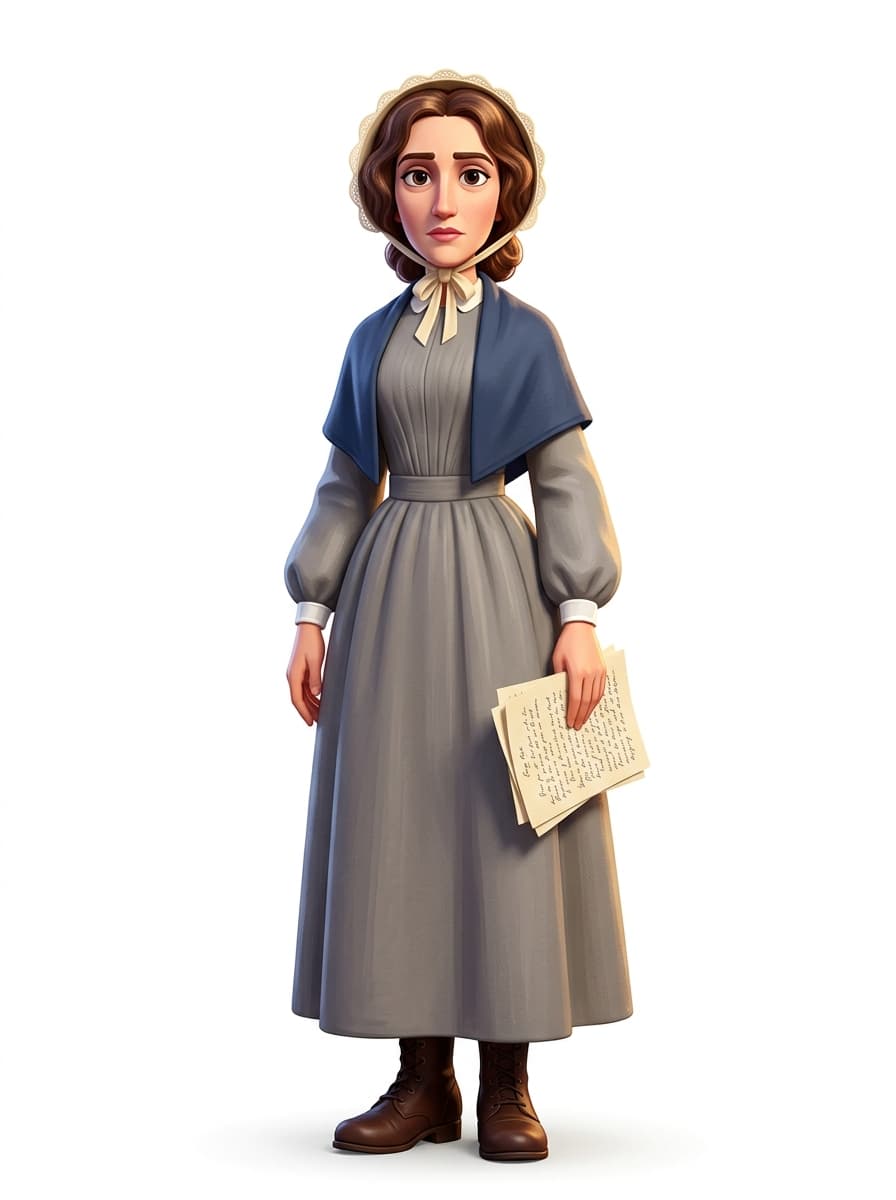
George Eliot
1819 – 1880
George Eliot was the pen name of Mary Ann Evans, an English novelist who wrote deeply thoughtful books like Middlemarch about ordinary people's lives. She chose to publish under a man's name so her serious novels would be taken seriously in a time when many people didn't respect women writers. She is now considered one of the greatest novelists in the English language, and Virginia Woolf famously called Middlemarch "one of the few English novels written for grown-up people."
Quotes
“Those who trust us educate us.”
“But what we call our despair is often only the painful eagerness of unfed hope.”
“In old days there were angels who came and took men by the hand and led them away from the city of destruction. We see no white-winged angels now. But yet men are led away from threatening destruction: a hand is put into theirs, which leads them forth gently towards a calm and bright land, so that they look no more backward; and the hand may be a little child’s.”
“Such friendship easily becomes tender: the one spreads strong sheltering wings that delight in spreading, the other gets the warm protection which is also a delight.”
“O may I join the choir invisible Of those immortal dead who live again In minds made better by their presence; live In pulses stirred to generosity, In deeds of daring rectitude, in scorn Of miserable aims that end with self, In thoughts sublime that pierce the night like stars, And with their mild persistence urge men’s minds To vaster issues.”
“Our dead are never dead to us until we have forgotten them: they can be injured by us, they can be wounded; they know all our penitence, all our aching sense that their place is empty, all the kisses we bestow on the smallest relic of their presence.”
“Two wedded from the portal stept: The bells made happy carolings, The air was soft as fanning wings, White petals on the pathway slept. O pure-eyed bride! O tender pride!”
“Two faces o'er a cradle bent: Two hands above the head were locked: These pressed each other while they rocked, Those watched a life that love had sent. O solemn hour! O hidden power!”
“The red light shone upon the floor And made the space between them wide; They drew their chairs up side by side, Their pale cheeks joined, and said, "Once more!" O memories! O past that is!”
“I love Tom so dearly, Luke,—better than anybody else in the world.”
“But I think Tom’s clever, for all he doesn’t like books; he makes beautiful whipcord and rabbit-pens.”
“Well, then, it’s a new fish-line—two new uns,—one for you, Maggie, all to yourself. I wouldn’t go halves in the toffee and gingerbread on purpose to save the money;”
“Maggie’s answer was to throw her arms round Tom’s neck and hug him, and hold her cheek against his without speaking,”
“If there came a lion roaring at me, I think you’d fight him, wouldn’t you, Tom?”
“Oh, Tom, please forgive me—I can’t bear it—I will always be good—always remember things—do love me—please, dear Tom!”
“Don’t cry, then, Magsie; here, eat a bit o’ cake.”
“I hope their brothers ’ull love the poor things, and remember they came o’ one father and mother; the lads ’ull never be the poorer for that,”
“And the more there is of ’em, the more they must love one another,”
“I’ll allays be a good brother to you.”
“But you oughtn’t to hate me, Tom; it’ll be very wicked of you, for I shall be your sister.”
“I wish you were my brother. I’m very fond of you. And you would stay at home with me when Tom went out, and you would teach me everything; wouldn’t you,—Greek and everything?”
“when I’m very unhappy, I shall always think of you, and wish I had a sister with dark eyes, just like yours.”
“Oh, Tom—dear, dear Tom, don’t fret too much; try and bear it well.”
“The two poor things clung closer to each other, both trembling,—the one at an unshapen fear, the other at the image of a terrible certainty.”
“I’ve always been good to my sister, though she married against my will, and I’ve lent Moss money; but I shall never think of distressing him to pay it; I’d rather lose it. My children must not mind being the poorer for that.”
“I desire no future that will break the ties of the past. But the tie to my brother is one of the strongest. I can do nothing willingly that will divide me always from him.”
“Mrs Tulliver cried a little in a trickling, quiet way as she put on her nightcap; but presently sank into a comfortable sleep, lulled by the thought that she would talk everything over with her sister Pullet to-morrow, when she was to take the children to Garum Firs to tea.”
“It had come across his mind that if he were hard upon his sister, it might somehow tend to make Tom hard upon Maggie at some distant day, when her father was no longer there to take her part; for simple people, like our friend Mr Tulliver, are apt to clothe unimpeachable feelings in erroneous ideas, and this was his confused way of explaining to himself that his love and anxiety for “the little wench” had given him a new sensibility toward his sister.”
““Maggie,” said Philip, after a minute or two, still leaning on his elbow and looking at her, “if you had had a brother like me, do you think you should have loved him as well as Tom?””
“Mr Stelling felt like a kind-hearted man; he foresaw a probable money loss for himself, but this had no appreciable share in his feeling, while he looked with grave pity at the brother and sister for whom youth and sorrow had begun together.”
“If we aren’t come together for one to hear what the other ’ull do to save a sister and her children from the parish, I shall go back.”
““Why do you come, then,” she burst out, “talking and interfering with us and scolding us, if you don’t mean to do anything to help my poor mother—your own sister,—if you’ve no feeling for her when she’s in trouble, and won’t part with anything, though you would never miss it, to save her from pain?”
“It was not at all agitating to Maggie to see Philip again; she retained her childish gratitude and pity toward him, and remembered his cleverness; and in the early weeks of her loneliness she had continually recalled the image of him among the people who had been kind to her in life, often wishing she had him for a brother and a teacher, as they had fancied it might have been, in their talk together.”
“Her brother was the human being of whom she had been most afraid from her childhood upward; afraid with that fear which springs in us when we love one who is inexorable, unbending, unmodifiable, with a mind that we can never mould ourselves upon, and yet that we cannot endure to alienate from us.”
“Along with the sense of danger and possible rescue for those long-remembered beings at the old home, there was an undefined sense of reconcilement with her brother; what quarrel, what harshness, what unbelief in each other can subsist in the presence of a great calamity, when all the artificial vesture of our life is gone, and we are all one with each other in primitive mortal needs?”
“Vaguely Maggie felt this, in the strong resurgent love toward her brother that swept away all the later impressions of hard, cruel offence and misunderstanding, and left only the deep, underlying, unshakable memories of early union.”
“The boat reappeared, but brother and sister had gone down in an embrace never to be parted; living through again in one supreme moment the days when they had clasped their little hands in love, and roamed the daisied fields together.”
“It was Tom’s step, then, that Maggie heard on the stairs, when her need of love had triumphed over her pride, and she was going down with her swollen eyes and dishevelled hair to beg for pity.”
“Tom, delighted with this verdict, telegraphed his triumph by wagging his head at Maggie, behind Mr Stelling’s chair.”
“He made his speech, asserting his honest principles with his old confident eagerness, alluding to the rascals and the luck that had been against him, but that he had triumphed over, to some extent, by hard efforts and the aid of a good son; and winding up with the story of how Tom had got the best part of the needful money.”
“But the streak of irritation and hostile triumph seemed to melt for a little while into purer fatherly pride and pleasure, when, Tom’s health having been proposed, and uncle Deane having taken occasion to say a few words of eulogy on his general character and conduct, Tom himself got up and made the single speech of his life.”
“Tom remained in St Ogg’s to attend to some business, and Mr Tulliver mounted his horse to go home, and describe the memorable things that had been said and done, to “poor Bessy and the little wench.” The air of excitement that hung about him was but faintly due to good cheer or any stimulus but the potent wine of triumphant joy.”
“As for dear little Lucy herself, her late benevolent triumph about the Mill, and all the affectionate projects she was cherishing for Maggie and Philip, helped to give her the highest spirits to-day, and she felt nothing but pleasure in the evidence of Maggie’s attractiveness.”
“He was master there now; he had half fulfilled his father’s dying wish, and by years of steady self-government and energetic work he had brought himself near to the attainment of more than the old respectability which had been the proud inheritance of the Dodsons and Tullivers.”
“The Tullivers had lived on this spot for generations, and he had sat listening on a low stool on winter evenings while his father talked of the old half-timbered mill that had been there before the last great floods which damaged it so that his grandfather pulled it down and built the new one.”
““No; only that my grandfather was a patriot—a bright fellow—could speak many languages—musical—got his bread by teaching all sorts of things.”
““I wonder whether you would like to have that miniature which hangs up-stairs—I mean that beautiful miniature of your grandmother.”
“The memory has as many moods as the temper, and shifts its scenery like a diorama.”
“For the fragment of a life, however typical, is not the sample of an even web: promises may not be kept, and an ardent outset may be followed by declension; latent powers may find their long-waited opportunity; a past error may urge a grand retrieval.”
“Marriage, which has been the bourne of so many narratives, is still a great beginning, as it was to Adam and Eve, who kept their honeymoon in Eden, but had their first little one among the thorns and thistles of the wilderness. It is still the beginning of the home epic—the gradual conquest or irremediable loss of that complete union which makes the advancing years a climax, and age the harvest of sweet memories in common.”
“Most of us, indeed, know little of the great originators until they have been lifted up among the constellations and already rule our fates.”
“Some gentlemen have made an amazing figure in literature by general discontent with the universe as a trap of dulness into which their great souls have fallen by mistake; but the sense of a stupendous self and an insignificant world may have its consolations.”