
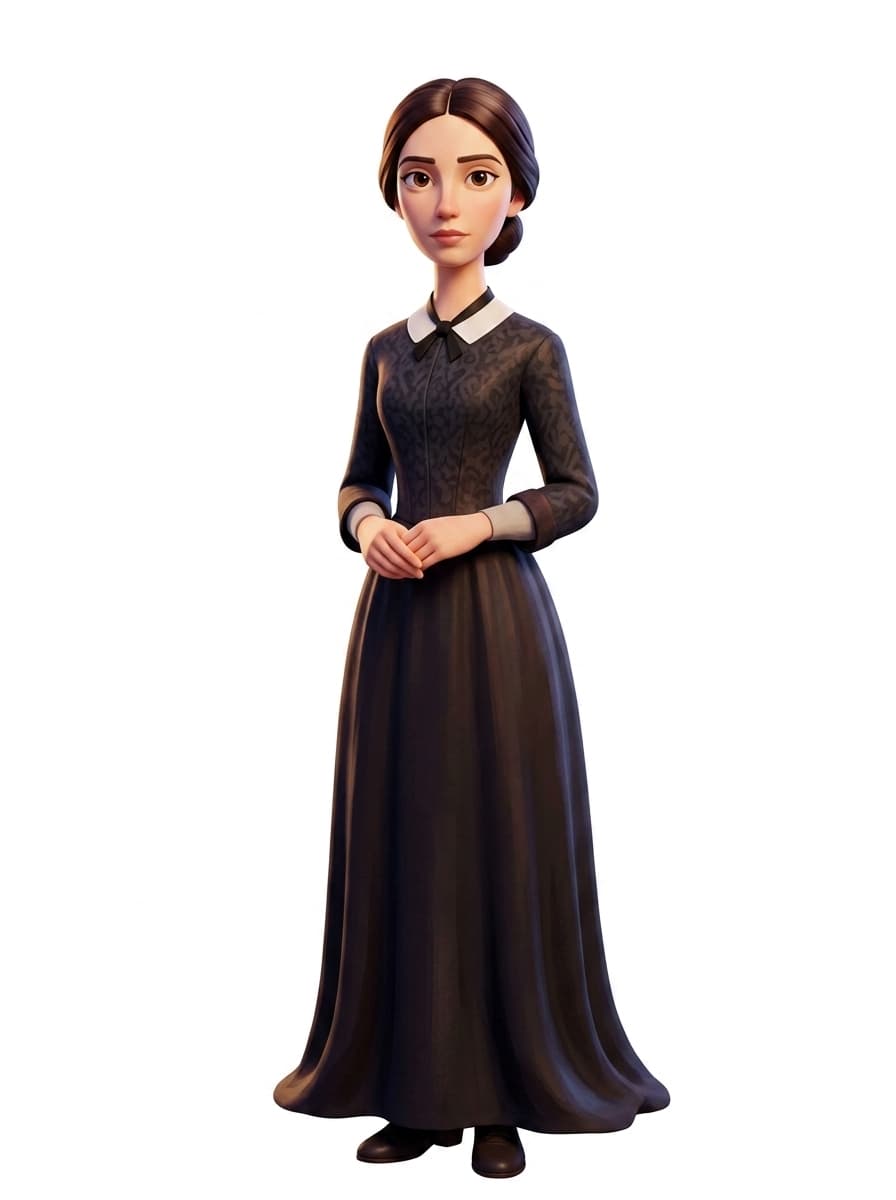
Emily Dickinson
1830 – 1886
Emily Dickinson wrote nearly 1,800 poems in Amherst, Massachusetts, in short lines full of dashes that made ordinary words feel startling and new. She lived her whole life in her family's house, where she baked the bread her father would eat from no one else, lowered baskets of gingerbread from her window to neighborhood children, and tended a garden and a small glass conservatory. As a schoolgirl she pressed and labeled more than 400 plants. In her later years she rarely left the house and spoke to some visitors only from behind a door, but she wrote letters constantly and sent poems and flowers to friends. Only about ten of her poems were printed while she lived, without her name or her consent, and editors changed her punctuation. So she published her own way: she copied finished poems in a fair hand and sewed them into about forty small booklets that she showed no one. Her sister Lavinia found them after her death in 1886 and had the first collection published in 1890.
Quotes
“My friends are my 'estate.' Forgive me then the avarice to hoard them.”
“Hope is the thing with feathers”
“If I can stop one heart from breaking, I shall not live in vain”
“I'm nobody! Who are you?”
“Success is counted sweetest by those who ne'er succeed.”
“There is no frigate like a book”
“The soul selects her own society”
“Because I could not stop for Death, he kindly stopped for me”
“We never know how high we are Till we are called to rise;”
“To fight aloud, is very brave - But gallanter, I know Who charge within the bosom The Cavalry of Wo -”
“A Moment—We uncertain step For newness of the night— Then—fit our Vision to the Dark— And meet the Road—erect—”
“If your Nerve, deny you -- Go above your Nerve --”
“The bustle in a house The morning after death Is solemnest of industries Enacted upon earth,— The sweeping up the heart, And putting love away We shall not want to use again Until eternity.”
“After great pain a formal feeling comes — The nerves sit ceremonious like tombs; The stiff Heart questions — was it He that bore? And yesterday — or centuries before? The feet mechanical go round A wooden way Of ground or air or Ought, Regardless grown, A quartz contentment like a stone. This is the hour of lead Remembered if outlived As freezing persons recollect The snow — First chill, then stupor, then The letting go.”
“Nature is what we see, The Hill, the Afternoon— Squirrel, Eclipse, the Bumble-bee, Nay—Nature is Heaven. Nature is what we hear, The Bobolink, the Sea— Thunder, the Cricket— Nay,—Nature is Harmony. Nature is what we know But have no art to say, So impotent our wisdom is To Her simplicity.”
“The brain is wider than the sky, For, put them side by side, The one the other will include With ease, and you beside. The brain is deeper than the sea, For, hold them, blue to blue, The one the other will absorb, As sponges, buckets do. The brain is just the weight of God, For, lift them, pound for pound, And they will differ, if they do, As syllable from sound.”
“I dwell in Possibility A fairer house than Prose, More numerous of windows, Superior of doors.”
“Since then 't is centuries; but each Feels shorter than the day I first surmised the horses' heads Were toward eternity.”
“After a hundred years Nobody knows the place, -- Agony, that enacted there, Motionless as peace.”
“The past is such a curious creature, To look her in the face A transport may reward us, Or a disgrace. Unarmed if any meet her, I charge him, fly! Her rusty ammunition Might yet reply!”
“I wonder if they bore it long, Or did it just begin? I could not tell the date of mine, It feels so old a pain.”
“If I could see you in a year, I'd wind the months in balls, And put them each in separate drawers, Until their time befalls.”
“But now, all ignorant of the length Of time's uncertain wing, It goads me, like the goblin bee, That will not state its sting.”
“I had no time to hate, because The grave would hinder me, And life was not so ample I Could finish enmity. Nor had I time to love; but since Some industry must be, The little toil of love, I thought, Was large enough for me.”
“The last night that she lived, It was a common night, Except the dying; this to us Made nature different.”
“A precious, mouldering pleasure 't is To meet an antique book, In just the dress his century wore; A privilege, I think, His venerable hand to take, And warming in our own, A passage back, or two, to make To times when he was young.”
“Look back on time with kindly eyes, He doubtless did his best; How softly sinks his trembling sun In human nature's west!”
“Nature, the gentlest mother, Impatient of no child, The feeblest or the waywardest, -- Her admonition mild In forest and the hill By traveller is heard, Restraining rampant squirrel Or too impetuous bird.”
“When all the children sleep She turns as long away As will suffice to light her lamps; Then, bending from the sky With infinite affection And infiniter care, Her golden finger on her lip, Wills silence everywhere.”
“Some keep the Sabbath going to church; I keep it staying at home, With a bobolink for a chorister, And an orchard for a dome. Some keep the Sabbath in surplice; I just wear my wings, And instead of tolling the bell for church, Our little sexton sings. God preaches, -- a noted clergyman, -- And the sermon is never long; So instead of getting to heaven at last, I'm going all along!”
“I taste a liquor never brewed, From tankards scooped in pearl; Not all the vats upon the Rhine Yield such an alcohol! Inebriate of air am I, And debauchee of dew, Reeling, through endless summer days, From inns of molten blue. When landlords turn the drunken bee Out of the foxglove's door, When butterflies renounce their drams, I shall but drink the more! Till seraphs swing their snowy hats, And saints to windows run, To see the little tippler Leaning against the sun!”
“The grass so little has to do, -- A sphere of simple green, With only butterflies to brood, And bees to entertain, And stir all day to pretty tunes The breezes fetch along, And hold the sunshine in its lap And bow to everything; And thread the dews all night, like pearls, And make itself so fine, -- A duchess were too common For such a noticing. And even when it dies, to pass In odors so divine, As lowly spices gone to sleep, Or amulets of pine. And then to dwell in sovereign barns, And dream the days away, -- The grass so little has to do, I wish I were the hay!”
“Who robbed the woods, The trusting woods? The unsuspecting trees Brought out their burrs and mosses His fantasy to please. He scanned their trinkets, curious, He grasped, he bore away. What will the solemn hemlock, What will the fir-tree say?”
“How happy is the little stone That rambles in the road alone, And doesn't care about careers, And exigencies never fears; Whose coat of elemental brown A passing universe put on; And independent as the sun, Associates or glows alone, Fulfilling absolute decree In casual simplicity.”
“Frequently the woods are pink, Frequently are brown; Frequently the hills undress Behind my native town. Oft a head is crested I was wont to see, And as oft a cranny Where it used to be. And the earth, they tell me, On its axis turned, -- Wonderful rotation By but twelve performed!”
“Apparently with no surprise To any happy flower, The frost beheads it at its play In accidental power. The blond assassin passes on, The sun proceeds unmoved To measure off another day For an approving God.”
“Here a star, and there a star, Some lose their way. Here a mist, and there a mist, Afterwards -- day!”
“I'll tell you how the sun rose, -- A ribbon at a time. The steeples swam in amethyst, The news like squirrels ran.”
“I lost a world the other day. Has anybody found? You'll know it by the row of stars Around its forehead bound.”
“The night was wide, and furnished scant With but a single star, That often as a cloud it met Blew out itself for fear.”
“The moon is distant from the sea, And yet with amber hands She leads him, docile as a boy, Along appointed sands.”
“The sun just touched the morning; The morning, happy thing, Supposed that he had come to dwell, And life would be all spring.”
“Arcturus is his other name, -- I'd rather call him star! It's so unkind of science To go and interfere!”
“The moon was but a chin of gold A night or two ago, And now she turns her perfect face Upon the world below.”
“And what a privilege to be But the remotest star! For certainly her way might pass Beside your twinkling door.”
“Of bronze and blaze The north, to-night! So adequate its forms, So preconcerted with itself, So distant to alarms, -- An unconcern so sovereign To universe, or me, It paints my simple spirit With tints of majesty, Till I take vaster attitudes, And strut upon my stem, Disdaining men and oxygen, For arrogance of them.”
“Each that we lose takes part of us; A crescent still abides, Which like the moon, some turbid night, Is summoned by the tides.”
Sources
- en.wikipedia.org
- poets.org
- emilydickinsonmuseum.org
- emilydickinsonmuseum.org
- emilydickinsonmuseum.org
- emilydickinsonmuseum.org